Charging and protection
Marine Battery Chargers and Electrical Equipment
On most boats the hardware around the battery costs between a third and a half of what the battery costs, and it is the part that decides whether the install works. A DC-DC charger so the alternator survives. A controller with a real lithium profile. A shunt, because lithium’s flat voltage curve makes guessing useless. And a fuse that can actually interrupt what the bank can deliver.
Pricing is indicative and not yet independently verified. Bands are compiled from published market pricing rather than quotes we obtained. No brand has paid to appear or be ranked.
- Products listed
- 24
- Categories
- 5
- Last reviewed
- 4 September 2026
Buy a system, not a pile of boxes
Match charging equipment to battery and system limits
The charger must suit the alternator and bank. The fuse must protect the cable and interrupt the available fault current. The shunt must see every load and charge source. Use the product pages to build a shortlist, then have the arrangement specified for the boat.
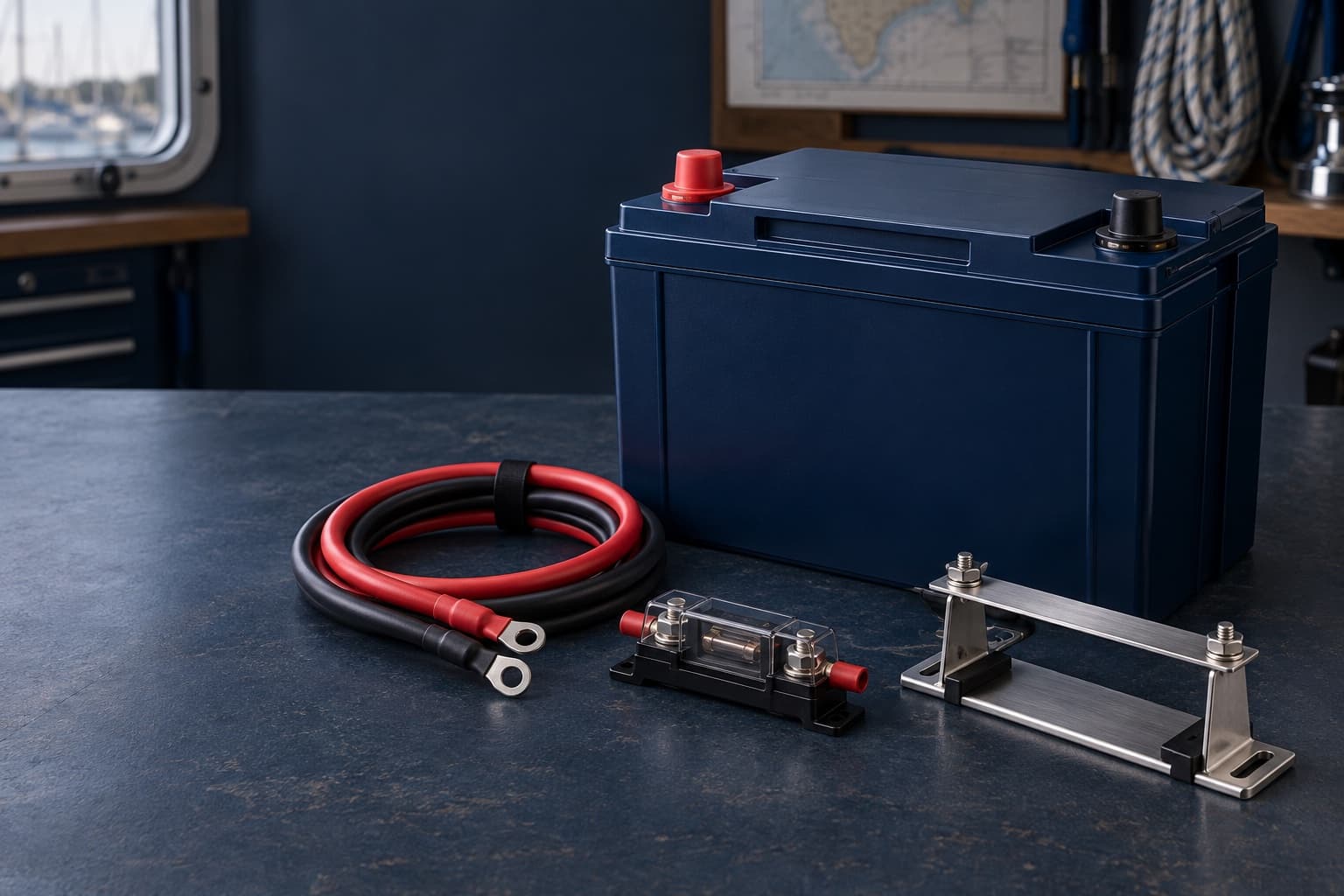
An empty lithium bank will accept almost every amp an alternator can produce, and an internally regulated alternator built for lead-acid will keep producing them until something inside it lets go. A DC-DC charger fixes the current the engine is asked for and keeps the BMS off your cranking circuit.
A marine solar controller must match the panel array and the installed battery. Check PV voltage and current limits, battery-approved charge settings, temperature protection and BMS controls.
On lead-acid you could read state of charge off the voltage and be roughly right. Lithium holds its voltage almost flat from 90% down to 20%, so voltage tells you nothing until it is telling you something urgent.
The inverter is what turns an adequate bank into an undersized one. A kettle drawing 85 A for twenty minutes is 28 Ah, and owners consistently underestimate it because the appliance is familiar and the current is not.
This is the least expensive category on the site and the one an insurer will ask about first. A lithium bank will deliver a fault current that a standard blade or ANL fuse cannot safely interrupt, which is why a Class-T fuse at the bank terminal is the specification.