Lithium is not an upgrade to your batteries. It is a change to your charging system — and most of the disappointment we hear about comes from owners who bought the first thing and the second thing separately.
01Lithium vs AGM: usable capacity and weight
A 600 Ah AGM bank reads as generous until you apply the discipline the chemistry demands. You may take it to half, not much further, and you should get it back to full most days or it will quietly sulphate its way to an early grave. The bank you paid for is 600 Ah. The bank you cruise with is 300, and only on the days you have been diligent.
Lithium iron phosphate changes the arithmetic in three ways that matter at anchor: you can use most of the capacity, you can put it back in at a rate the bank will actually accept, and the voltage holds up while you do it — so the fridge is not slowing down at three in the morning. A 400 Ah lithium bank delivers more usable energy than 600 Ah of AGM, weighs around 90 kg less, and recharges in a fraction of the engine hours.
That last point is the one owners underestimate. On a liveaboard the constraint is rarely capacity — it is how long you are willing to sit listening to the engine to replace what you used. Lithium is, in practice, a charging upgrade you happen to be storing energy in.
Lithium is not an upgrade to your batteries. It is a change to your charging system.The claim this whole guide rests on
02Marine lithium battery disadvantages
No guide that skips this chapter is worth reading. Six things to weigh before you commit.
The bill arrives at the start
Lithium is cheaper per usable amp-hour over a decade and considerably more expensive on the day. If the boat is for sale within two years you will not recover it.
It is a charging project
The cells are the easy part. DC-DC charging, a lithium-profile mains charger, adequate cable and fusing, and a monitor you trust are all part of the job, not extras.
Cold charging is a genuine limit
Below freezing, LiFePO4 must not be charged without low-temperature protection or heating. Irrelevant in the tropics, real in Tasmania and alpine storage.
The BMS is a single point of failure
A protective disconnect is a feature until it happens at three in the morning with the fridge full. Redundancy and a way to get home matter on a cruising boat.
Insurers and marinas are paying attention
Expect questions about the BMS, the enclosure and the certification. An undocumented install is a claim problem waiting for its moment.
The market is noisy
Cycle-life and capacity claims at the budget end are frequently optimistic. We publish what we measure and label everything else as claimed.
03Is a lithium boat battery right for you?
Four questions, in this order. Answering them out of order is how people end up with a beautiful bank and an alternator on the workbench.
Step one
How many nights do you actually spend away from shore power?
Not the best trip you ever had — the ordinary fortnight. Everything downstream scales off this number, and inflating it is the most expensive mistake in the process.
Step two
What is your real daily consumption?
Measure it if you can. A shunt-based monitor on the existing bank for one representative fortnight is worth more than any estimate, including ours.
Step three
What can you put back in, and how fast?
Solar first, because it is silent and it is already there. Then the alternator through a DC-DC charger sized to the engine, not to the bank. Shore power last — it is the source you have least often.
Step four
What does the compartment allow?
Dimensions, ventilation, and whether the existing cable runs can carry the currents lithium will invite. This is the question that decides between one large bank and two smaller ones.
04How to calculate boat battery capacity
Daily consumption is the sum of every load in amps multiplied by the hours it actually runs — not the hours the brochure assumes. Divide by the usable fraction of the chemistry: 0.8 for LiFePO4, 0.5 for AGM. Multiply by the nights you intend to spend away from shore power. Subtract what your solar genuinely returns on an average day, which in most of Australia is panel watts times about four and a quarter sun-hours, derated a quarter for heat, dirt, shading and controller loss.
We do not let solar zero out the bank. A bank sized on a perfect solar day is a bank that fails on the third grey one, so the calculator credits solar at half of its average return and never sizes the bank below half your gross daily draw. On the reference 38-footer — 149 Ah a day, three nights, 400 W on the arch — that lands on 400 Ah, which is exactly the bank we specify on the boat page.
Run it on your own numbers
The house bank calculator takes your loads, your nights on the hook, your solar and your alternator, and returns the bank, the DC-DC charger, the AGM equivalent and the weight you take off the boat.
Open the calculator05Marine lithium battery installation requirements
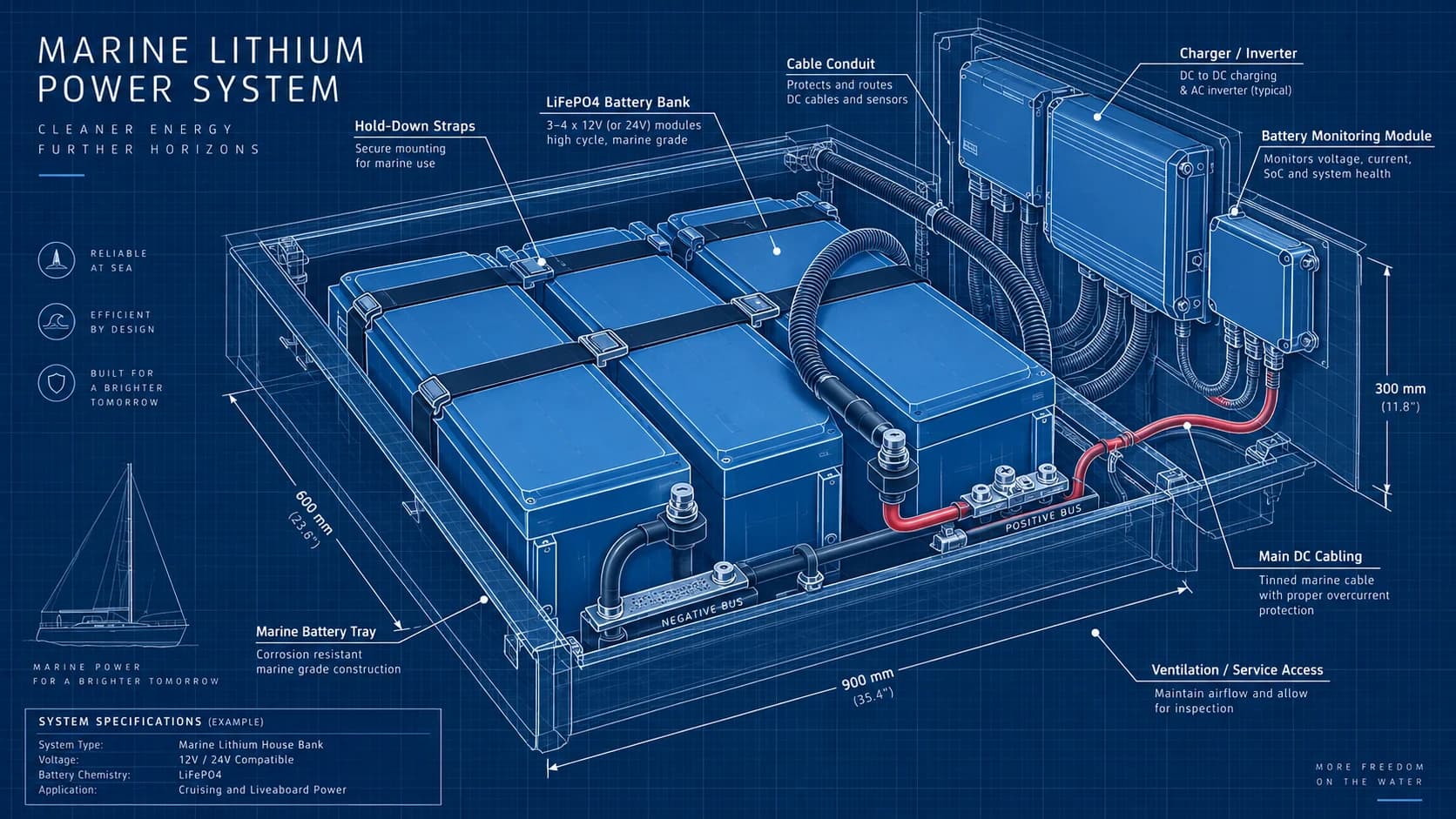
Budget for the system, not the batteries. On a 38 ft yacht a competent lithium conversion is a DC-DC charger sized to the alternator, a lithium-profile mains charger, a shunt-based monitor you will actually read, new cable where the old runs are undersized for the currents lithium invites, fusing at the bank, and a compartment that is ventilated and mechanically sound. On most boats the hardware around the cells costs between a third and a half of what the cells cost.
The most common shortcut we see is reusing the existing alternator regulation and hoping the BMS will be polite about it. It will not be. An empty lithium bank asks for everything the alternator can produce, and an internally regulated unit designed for lead-acid will supply it until something in it fails — usually on the first long motor, usually a long way from a workshop.
06Boat battery standards, insurance and marina requirements
Lithium is not prohibited as a chemistry on Australian recreational vessels, but the requirements depend on the vessel, system voltage and state or territory. AS/NZS 3004.2 covers boat installations; commercial-vessel rules and electrical-licensing laws can add obligations. Document the design and have a suitably competent person assess it, using a licensed electrician wherever the applicable law or work requires one. Confirm insurer and marina evidence requirements before buying equipment.
We publish the questions we have seen from Australian insurers verbatim, with the paperwork that satisfies them, in the compliance cluster.
07Marine lithium battery FAQs
Will lithium damage my alternator?
It can, and the failure mode is well documented. An empty LiFePO4 bank accepts very high current, so a small internally regulated alternator runs at full output until its diodes or windings give up. A DC-DC charger limits the current and removes the risk.
Can I keep AGM for starting and run lithium for the house?
Yes, and on a cruising yacht that is usually the right architecture. Separate banks, separate charge profiles, joined only through a DC-DC charger or a managed relay — never sharing a bus.
Will my existing mains charger work?
Only if it has a genuine lithium profile. A lead-acid charger holds a float voltage lithium does not want, and its desulphation pulse is the sort of thing a BMS disconnects from.
How long will 400 Ah run my fridge?
On its own, a typical 12 V marine fridge drawing 5 A at a 45% duty cycle uses about 54 Ah a day, so roughly six days of usable capacity — before the rest of the boat is counted. The calculator does the rest of the boat.
Is a drop-in battery or a DIY cell build better?
For most owners, drop-in. A DIY build can be excellent and cheaper, but it makes you the manufacturer for warranty, insurance and survey purposes, and that is a bigger commitment than the wiring suggests.